
For international buyers sourcing wood furniture and doors from Indonesia, the conversation usually starts with Java. What often gets overlooked is exactly where in Java a factory sits, and how much that location shapes cost, quality, and shipping reliability. Boyolali, a regency in Central Java’s Solo Raya region, has quietly become one of those locations worth knowing.
While Jepara tends to dominate the spotlight for carved teak, the wider Central Java region is home to a deep woodworking tradition and a growing base of export-oriented manufacturers. Boyolali, sitting between Salatiga and Solo, benefits from that heritage while adding something many older clusters lack: modern logistics access.
Contents
Where Is Boyolali, and Why Does It Matter for Wood Manufacturing?
Boyolali is a regency in Central Java, just northwest of Solo (Surakarta), set against the slopes of Mount Merbabu. It belongs to the Solo Raya economic area, a region with a long history of furniture making, carpentry, and timber processing. For manufacturers, this means access to a workforce that already understands woodworking, from joinery and finishing to large-scale production.
The region also sits close to Central Java’s timber supply chains. Hardwoods commonly used for export furniture and doors, such as teak and mahogany, are widely processed across Java, and Central Java in particular has a mature ecosystem of sawmills, kiln-drying facilities, and component suppliers. For buyers, a Central Java base often translates into more consistent raw material sourcing and skilled finishing at competitive labor costs. You can read more about the regency on its official encyclopedic profile.
Logistics: The Real Advantage of a Boyolali Base
Craftsmanship matters, but for export, logistics often makes or breaks a supplier relationship. This is where Boyolali has changed dramatically over the past decade. Once seen mainly as a quiet agricultural area, the regency now sits on one of the busiest arteries of the Trans-Java toll network, earning it a reputation as a new economic “golden triangle” connecting Jakarta, Surabaya, and Yogyakarta.
For a furniture and door manufacturer shipping containers abroad, the practical advantages look like this:
- Direct toll access. The Semarang to Solo toll road runs straight through Boyolali, with several exits such as Banyudono, Mojosongo, and Ngemplak, linking the regency northward to Semarang and eastward toward the Solo to Ngawi toll.
- Seaport proximity. Tanjung Emas Port in Semarang, Central Java’s main export gateway, is roughly 70 to 80 kilometers away by toll, making container shipping to global markets straightforward.
- Air access on its doorstep. Adi Soemarmo International Airport is located within Boyolali itself, which is convenient for buyer visits, audits, and air-freighted samples.
- Trans-Java connectivity. Beyond exports, the same network supports domestic distribution toward Jakarta, Yogyakarta, and Surabaya.
That combination of road, sea, and air access is unusual for an inland manufacturing area. It is the same principle that shapes economies built around freight, much like how regional logistics networks shape a port-anchored city such as Tacoma. In Boyolali’s case, the proximity to Tanjung Emas Port shortens the distance between the factory floor and the buyer’s destination.
A Manufacturer Rooted in Boyolali: Nusantara Wood
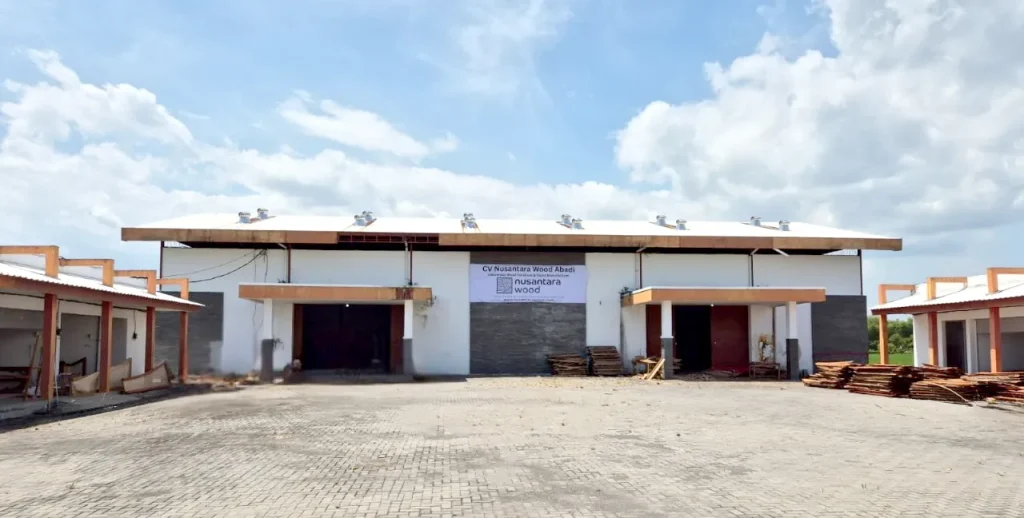
One company that illustrates this location advantage well is Nusantara Wood, operated under the legal entity CV Nusantara Wood Abadi. As an Indonesia wood furniture and doors manufacturer, it has produced solid wood furniture, doors, flooring, and decking for international markets since 2009, combining traditional craftsmanship with modern machinery.
Its factory is located within Boyolali’s Sentra Industri Kayu, a government-supported woodworking industrial cluster, while operating as an independent, export-focused facility. That positioning gives it the benefits of cluster infrastructure together with dedicated production capacity, a useful balance for importers who need both reliability and direct accountability.
A few details stand out for buyers evaluating an Indonesian supplier. The company works primarily with solid hardwoods such as teak and mahogany, materials valued for durability and appearance. It is also SVLK certified, referring to Indonesia’s Timber Legality Verification System, which confirms that the wood is legally sourced and traceable. For exporters shipping to markets with strict timber legality requirements, such as the European Union, this certification is an important compliance signal. Beyond standard catalogs, the factory supports custom OEM and ODM projects, and produces solid wood doors for both residential and commercial use alongside its furniture lines.
Its customer base reflects the export orientation of the region, spanning importers, wholesalers, retail chains, and contractors across Asia, Europe, and the Middle East. For these buyers, the value is not only the product but the supply chain behind it: skilled labor, legal timber, and a clear route to the nearest international port.
Why Location Should Be Part of Your Sourcing Decision
When comparing furniture and door suppliers in Indonesia, it is easy to focus only on price and product photos. Yet a factory’s location quietly influences lead times, shipping costs, and how easily you can visit and verify operations. A Boyolali base, with its blend of Central Java craftsmanship, legal and sustainable timber, and direct toll access to Tanjung Emas Port, offers a practical foundation for a dependable supply chain. For buyers building long-term sourcing from Indonesia, that is exactly the kind of detail worth weighing before signing a purchase order.